1.Florence, Italy: field report
Florence is a compact city with an outsized claim on the history of art. Roman streets lie beneath medieval towers; a brick dome crowns the skyline; and paintings once commissioned by bankers now hold up entire museum queues. This is the home of Dante, the Medici and Michelangelo’s David, but also of market stalls, working churches and sandwiches that require both hands. Come for the Renaissance, stay for the Tuscan table, and leave enough unplanned time to cross the Arno and watch the city turn gold.
2.The Layers of History
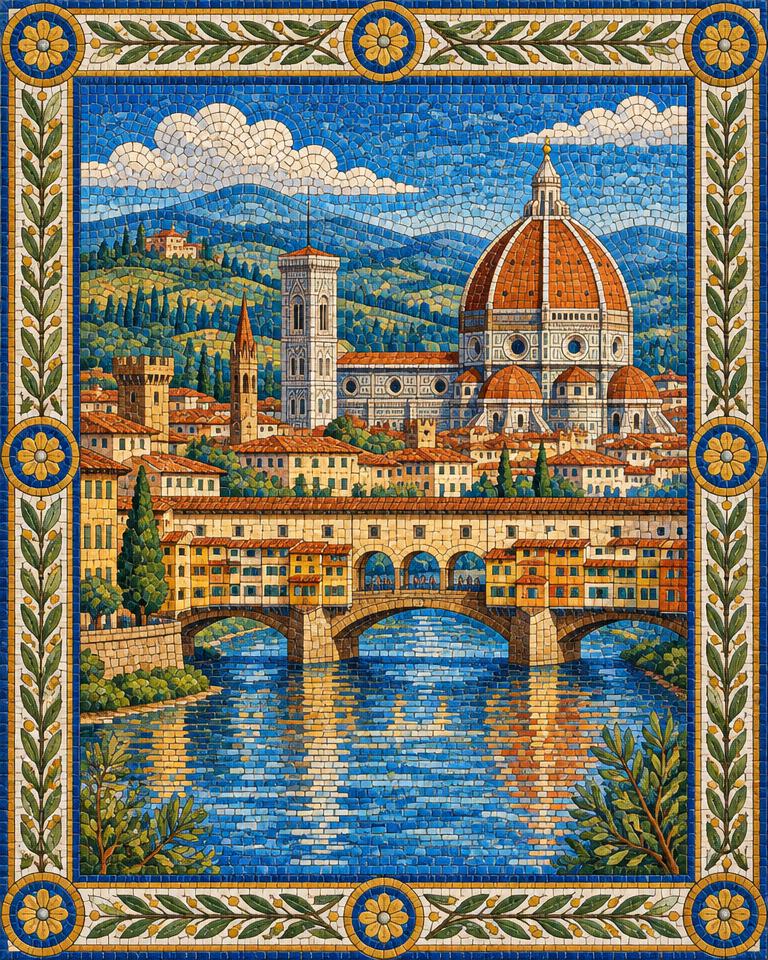
Around the beginning of the Christian era: Florence was Florentia, a Roman settlement on the Arno. Its foundation is conventionally dated to 59 BC, although the precise date and circumstances remain debated. The regular street grid survives in the centre: today’s Piazza della Repubblica occupies the area of the ancient forum. Nearby Fiesole, on the hill above the city, has an older Etruscan past and a Roman theatre. The Renaissance did not build on an empty field.
Around AD 500: the city belonged to the Ostrogothic kingdom following the end of the Western Roman Empire. The Gothic War of 535–554 disrupted Tuscany as Byzantine and Gothic armies fought for Italy; Lombard rule followed later in the sixth century. The exact early history of the city’s Christian shrines is less tidy than a visitor’s timeline might suggest. Saint Zenobius, traditionally a bishop around the late fourth and early fifth centuries, became Florence’s patron, and his relics are venerated in the cathedral. These are local church traditions, not a Florentine counterpart to Rome’s apostolic tombs.
Around AD 1000: Florence was growing into a medieval trading city, under the wider authority of the Tuscan margraves. Matilda of Tuscany became a powerful supporter of the papacy in the later eleventh century; after her death in 1115, the city’s self-governing commune developed. Wool production, merchants and banking would make Florence rich. The gold florin, first struck in 1252, became a major international currency: the city was exporting money before it exported museum tickets.
The thirteenth and fourteenth centuries: prosperity did not mean harmony. Guelph and Ghibelline rivalries, then divisions within the Guelphs, turned politics into a dangerous business. Dante Alighieri, born in 1265, was exiled in 1302 and never returned. The cathedral was begun in 1296, the Palazzo Vecchio in 1299, and the city endured the Black Death in 1348. Its surviving buildings are not just pretty backdrops: they express the ambitions of guilds, civic government and competing religious orders.
The fifteenth-century Renaissance: Cosimo de’ Medici returned from exile in 1434 and established his family’s dominance without immediately abolishing the republic’s institutions. Banking wealth and patronage supported an extraordinary artistic world. Brunelleschi built the cathedral dome between 1420 and 1436; Donatello reshaped sculpture; Botticelli painted for elite patrons. Under Lorenzo the Magnificent, Florence became a cultural powerhouse — though the Pazzi conspiracy of 1478 is a useful reminder that Renaissance dinner invitations occasionally came with political complications.
Around AD 1500: Medici rule had been interrupted by expulsion in 1494 and the upheaval associated with the preacher Savonarola, executed in 1498. Michelangelo carved David in 1501–1504 for the cathedral project, but the republic placed it outside Palazzo Vecchio as a civic symbol. The Medici returned in 1512; after another republican interval and a siege, their rule was restored in 1530. Cosimo I became duke in 1537 and grand duke of Tuscany in 1569. His Uffizi began as offices, not a gallery, and his family’s move across the river transformed Pitti Palace and Boboli.
From grand duchy to modern city: after the last Medici grand duke died in 1737, Tuscany passed to the House of Lorraine. Anna Maria Luisa de’ Medici’s Family Pact helped keep the family’s artistic collections in Florence. The city became the capital of unified Italy from 1865 to 1871, when new avenues and Piazzale Michelangelo altered the skyline. In 1944 retreating German forces destroyed all the city’s Arno bridges except Ponte Vecchio. The Arno flood of 4 November 1966 devastated homes, books and artworks; international volunteers known as the “mud angels” joined the rescue. Florence’s beauty is inherited, but its preservation has been hard work.
3.Top 10 Things to See
- 1Florence Cathedral & Brunelleschi’s Dome
Cathedral begun 1296 · dome 1420–1436 · façade 1876–1887
Brunelleschi raised the enormous brick dome without conventional full timber centring. Inside, the cathedral is surprisingly spare; the climb reveals its double shell and a close encounter with the Last Judgment frescoes. The dome climb needs a reserved time slot.
- 2Baptistery of San Giovanni
Consecrated 1059 · Gates of Paradise 1425–1452
An octagonal church older than the present cathedral, with a glittering mosaic ceiling. Ghiberti’s celebrated east doors are replicas outdoors; the originals are protected in the cathedral museum. Check current restoration access before visiting; ceiling mosaics may be obscured during works.
- 3Uffizi Gallery
Begun 1560 · public museum from 1769
Built by Giorgio Vasari as government offices for Cosimo I, the Uffizi now holds Botticelli’s Birth of Venus and Primavera alongside works by Leonardo, Michelangelo and Caravaggio. Give it a proper morning rather than a sprint between famous paintings.
- 4Accademia & Michelangelo’s David
Academy founded 1784 · David carved 1501–1504; moved here 1873
The original David stands indoors under a purpose-built tribune. Michelangelo’s unfinished Prisoners make the approach almost as compelling: bodies seem to struggle out of the stone. The figure outside Palazzo Vecchio is a copy.
- 5Ponte Vecchio
Present bridge 1345 · goldsmiths installed 1593
Florence’s shop-lined bridge once housed butchers; Ferdinand I replaced them with goldsmiths. The elevated Vasari Corridor connects the Medici’s offices and palace. The bridge survived the destruction of the city’s other bridges in 1944, although nearby streets did not.
- 6Palazzo Vecchio
Begun 1299 · major Medici alterations 16th c.
The crenellated tower and fortress-like walls announce that medieval government was not a gentle occupation. Inside are grand state rooms, the immense Salone dei Cinquecento and the Medici’s richly decorated private apartments; outside, Piazza della Signoria is an open-air sculpture collection.
- 7Basilica of Santa Croce
Present church begun 1294 or 1295 · consecrated 1443 · façade 1857–1863
The Franciscan basilica houses the tombs of Michelangelo, Galileo, Machiavelli and Rossini, with frescoes by Giotto and the Pazzi Chapel in the complex. Dante has a memorial here, not his body: his tomb is in Ravenna.
- 8Basilica of Santa Maria Novella
Present church begun 1279 · Alberti’s façade completed 1470
Behind the geometric marble façade are Masaccio’s Holy Trinity, an early masterpiece of painted perspective, and Ghirlandaio’s fresco cycle in the Tornabuoni Chapel. This Dominican church makes a rewarding counterpoint to Franciscan Santa Croce.
- 9Pitti Palace & Boboli Gardens
Palace begun mid-15th c. · Medici purchase c. 1550 · gardens developed from 16th c.
Across the Arno, the palace’s heavy stone frontage conceals opulent rooms and the Palatine Gallery. Behind it, Boboli climbs through terraces, sculpture and formal avenues. Palace and garden access are distinct ticket choices; leave time and energy for the hills.
- 10Piazzale Michelangelo
Laid out 1869 by Giuseppe Poggi
The classic rooftop panorama across the Arno, built when Florence was Italy’s capital. The David here is bronze, not the original marble. Continue uphill to San Miniato al Monte for Romanesque architecture and a quieter view.
4.Top 6 Things to Eat
- Bistecca alla fiorentina
Longstanding Tuscan tradition · precise origin disputed
A very thick T-bone or porterhouse, often from Chianina cattle, grilled over embers and served rare. It is usually priced by weight and shared: ask the weight and price before ordering, unless dinner is meant to become a financial Renaissance.
- Ribollita
Traditional Tuscan cucina povera · no securely dated invention
Bread, beans and cavolo nero make a substantial vegetable soup, reheated until yesterday’s leftovers become today’s best idea. Seasonal greens and a good finishing olive oil matter more than decorative flourishes.
- Lampredotto
Florentine offal tradition · exact beginnings uncertain
The cow’s fourth stomach, simmered in broth, sliced into a bun and finished with salsa verde or chilli. Order from a trippaio; the broth-dipped bread is part of the pleasure, not a structural mistake.
- Pappa al pomodoro
Post-Columbian tomato dish · popularised nationally in the 20th c.
Stale Tuscan bread turns tomatoes, garlic, basil and olive oil into a thick, comforting spoonful. The bread is traditionally unsalted, and the result is closer to a savoury bread pudding than a light tomato soup.
- Schiacciata
Traditional Tuscan flatbread · schiacciata all’uva is a harvest speciality
Olive-oil flatbread with a salty, dimpled crust, eaten plain or filled with pecorino and cured meats. In grape-harvest season, seek schiacciata all’uva, the sweet version baked with dark grapes.
- Florentine Gelato
Renaissance frozen-dessert traditions · modern gelato evolved later
Florence proudly associates frozen desserts with the Medici court and Bernardo Buontalenti, but a single inventor of modern gelato is not established. Choose restrained colours and seasonal flavours; pistachio need not glow like a traffic signal.
5.Final Dispatch
Reserve the dome climb and the major museums ahead through their own ticket pages, then resist the temptation to schedule every minute. A satisfying day might join the cathedral quarter to Piazza della Signoria, cross Ponte Vecchio into the Oltrarno, and finish above the river at sunset. Florence’s centre rewards walking; its stone pavements and garden slopes reward sensible shoes. Between masterpieces, visit a market, eat something seasonal and notice the workshops still making things by hand. The Renaissance is the headline, not the whole city.