1.Venice, Italy: field report
Venice should not exist. It is a city of 118 small islands, built on millions of wooden piles driven into lagoon mud, without a single car, where the bus is a boat and the ambulance is too. For a thousand years it was an independent republic that traded with Constantinople, Alexandria and the whole Mediterranean, and it spent the profits on gold mosaics, marble palaces and Titian. Come for St Mark’s and the Grand Canal, then get gloriously lost in the back lanes, where the crowds vanish and the laundry takes over.
2.The Layers of History
Around the beginning of the Christian era: there was no Venice yet. The lagoon’s shores belonged to the Roman region of Venetia et Histria, whose great city was Aquileia, one of the largest towns of the empire. The islands themselves held fishermen, salt-workers and perhaps a few villas. Venice’s founding myth claims 25 March 421 at noon, a date that is charmingly precise and almost certainly invented.
Around AD 500: mainland people were retreating into the marshes. Attila’s Huns sacked Aquileia in 452, and the Lombard invasion of 568 pushed many more families onto islands like Torcello, where shallow, shifting channels made a better wall than stone. In 537 the Roman official Cassiodorus described the lagoon dwellers living “like water birds,” rich in salt rather than gold. The settlements stayed formally under the Byzantine Empire, a connection that shaped Venice for centuries.
Around AD 1000: the islands had a doge (traditionally from 697) and a capital at the Rialto from 810–11. In 828 Venetian merchants stole the body of Saint Mark from Alexandria, giving the city an apostle-level patron and a winged lion for its flag. Around the year 1000, Doge Pietro II Orseolo cleared Adriatic pirates; the annual “Marriage of the Sea,” when the doge throws a ring into the water, celebrated that mastery. A Byzantine charter of 1082 handed Venice tax-free trade across the empire.
Crusade and empire, 1200s–1400s: in 1204 the Fourth Crusade, steered by the blind, elderly doge Enrico Dandolo, sacked Christian Constantinople instead of reaching Jerusalem. Venice took Crete, Aegean islands and the bronze horses now in St Mark’s. Marco Polo set out for China in 1271. Venice fought four wars with rival Genoa, won the last at Chioggia in 1380, and in 1348 lost perhaps half its people to the Black Death. Its Arsenal could reportedly assemble a galley in a single day: an industrial shipyard centuries before the term.
Around AD 1500: Venice was at its peak and starting its long slide. It ruled a mainland empire from Bergamo to Friuli, and its presses, led by Aldus Manutius, made it Europe’s publishing capital. But the Ottomans had taken Constantinople in 1453, Portuguese ships reached India by sea in 1498, and in 1509 a European alliance crushed Venice at Agnadello. The Venetian Ghetto, established in 1516, gave the world its word for a segregated quarter. Meanwhile Bellini, Giorgione, Titian, Tintoretto and Veronese turned Venetian colour into a school of painting.
From republic to modern city: the plague of 1630 inspired the Salute; the 18th century brought carnival, Vivaldi, Canaletto and Casanova. In 1797 Napoleon ended the 1,100-year republic without a battle, and Venice passed to Austria before joining Italy in 1866. A railway bridge (1846) and a road bridge (1933) tied it to the mainland. The flood of 4 November 1966 — the same day the Arno drowned Florence — set off an international rescue effort, and since 2020 the MOSE barriers have risen to hold back the highest tides. The city’s resident population has fallen below 50,000; please be a good guest.
3.Top 10 Things to See
- 1St Mark’s Basilica
Present church begun 1063 · consecrated 1094 · mosaics 11th–13th c. onward
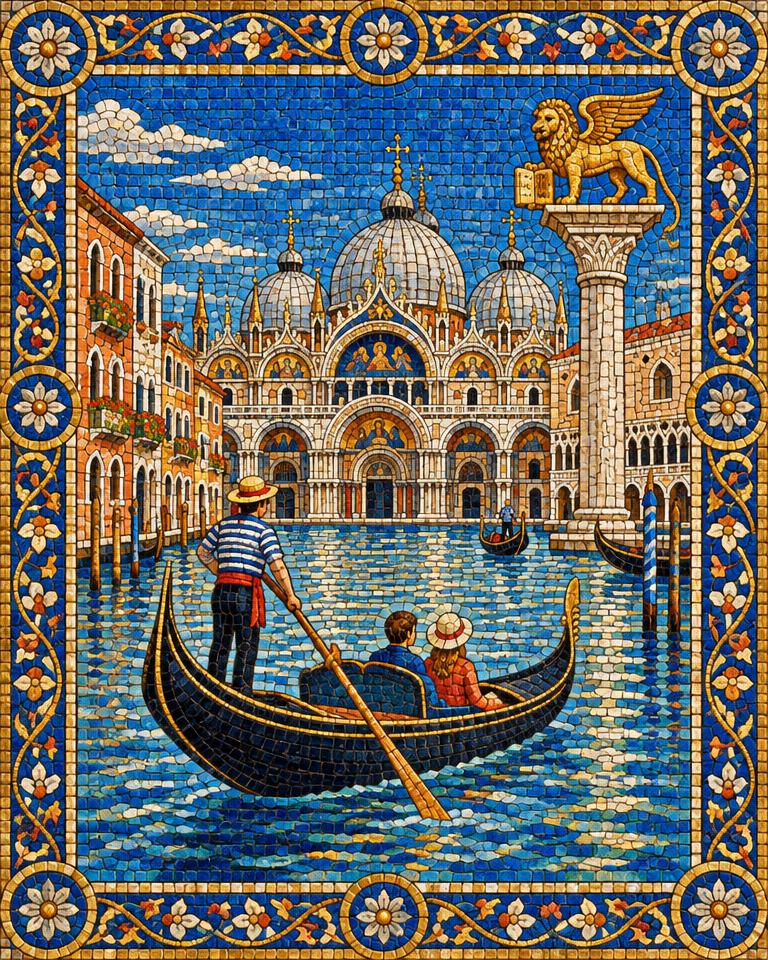
Built to house the relics of Saint Mark, smuggled out of Alexandria in 828 — legend says under a layer of pork to deter inspectors. Its domes and more than 8,000 square metres of gold mosaic show how closely Venice looked to Constantinople. The four bronze horses inside are originals looted from Constantinople in 1204; the ones on the façade are copies.
- 2Campanile of St Mark’s
Original tower completed 12th c. · collapsed 1902 · rebuilt 1912
The brick bell tower collapsed without warning on 14 July 1902, killing only the caretaker’s cat. It was rebuilt ‘where it was, as it was’ and reopened in 1912. A lift takes you to the belfry for the best view over the domes, the lagoon and, on clear days, the Alps.
- 3Doge’s Palace
Gothic waterfront wing c. 1340 · rebuilt after fires 1574 and 1577
The seat of the doge, the councils and the courts of the Venetian Republic. The pink-and-white façade seems to float on its arcades. Inside, Tintoretto’s Paradise fills the Great Council Hall; the Secret Itineraries tour adds the prisons and Casanova’s escape route.
- 4Bridge of Sighs
Built c. 1600–1603
An enclosed white limestone bridge linking the palace’s interrogation rooms to the New Prisons. The romantic name came from Lord Byron in the 19th century; prisoners crossing it probably sighed for more practical reasons. You walk through it on the Doge’s Palace visit.
- 5Rialto Bridge
Stone bridge 1588–1591 · earlier wooden bridges from the 12th c.
For centuries the only bridge across the Grand Canal. Antonio da Ponte’s single stone arch replaced a wooden drawbridge that had collapsed under a crowd in 1444. Next to it, the Rialto fish and produce markets still trade every morning except Sunday and Monday.
- 6Ca’ d’Oro
Built 1421–c. 1440
The ‘Golden House’ was once gilded and painted on its lace-like Gothic façade. Today it holds the Galleria Franchetti, with Mantegna’s Saint Sebastian, and a loggia overlooking the Grand Canal. Arrive by vaporetto line 1 to see the façade as intended — from the water.
- 7Frari Basilica
Present church c. 1250s–1338 onward · consecrated 1492
The great brick Franciscan church of Santa Maria Gloriosa dei Frari holds Titian’s blazing Assumption over the high altar and his tomb, along with Canova’s pyramid monument. It is plain outside and astonishing inside, which is a very Franciscan way to show off.
- 8Gallerie dell’Accademia & Accademia Bridge
Gallery opened 1817 · wooden bridge 1933, rebuilt 1985–86
The gallery is the essential collection of Venetian painting: Bellini, Giorgione, Titian, Tintoretto, Veronese and Carpaccio. The wooden bridge outside was meant to be temporary; Venice grew fond of it, and its crown gives the classic view down the Grand Canal to the Salute.
- 9Santa Maria della Salute
Vowed 1630 · built 1631–1687
Venice built this domed white church in thanks for deliverance from the plague of 1630, which killed roughly a third of the city. Every 21 November a temporary pontoon bridge carries pilgrims across the Grand Canal for the Festa della Salute. The sacristy holds paintings by Titian and Tintoretto.
- 10San Giorgio Maggiore
Palladio’s church begun 1566 · completed 1610
Palladio’s white church sits on its own island across the basin from St Mark’s. Take the vaporetto one stop, then ride the lift up the campanile for the best view of the Doge’s Palace and Piazzetta — usually with shorter queues than the tower on St Mark’s Square.
4.Top 6 Things to Eat
- Cicchetti
Bàcaro tradition · documented in Venetian taverns for centuries
Small bites eaten standing at a bàcaro: crostini of baccalà, meatballs, fried olives, folded tramezzini. Point at the counter, pay per piece and move on to the next bar. Dinner by instalments is a legitimate Venetian strategy.
- Sarde in saor
Sailors’ preserving dish · associated with Venice since at least the 14th c.
Fried sardines layered with onions softened in vinegar, often with raisins and pine nuts. The sweet-and-sour marinade kept fish edible on long voyages; it also tastes better the next day, which is more than most of us can say.
- Baccalà mantecato
Stockfish trade from Norway · Venetian tradition from the 15th c.
Dried cod soaked, poached and whipped with olive oil into a pale cream, spread on bread or grilled polenta. The habit traces back to a Venetian captain shipwrecked in Norway in 1432 who came home with stockfish.
- Risotto al nero di seppia
Lagoon tradition
Risotto turned jet black with cuttlefish ink, sweet and briny. Your teeth will be briefly Gothic; consider it local colour.
- Fegato alla veneziana
Venetian classic · roots possibly Roman
Thin strips of calf’s liver cooked quickly with a large heap of slowly softened onions, usually served with polenta. The onions do the heavy lifting; even sceptics are sometimes converted.
- Tiramisù & spritz
Tiramisù: Veneto, 1960s–70s · spritz: 19th–20th c.
Tiramisù is a regional invention claimed by Treviso, just inland. Pair it — or precede it — with a spritz of Aperol or Select, the bitter aperitivo created in Venice in 1920. The spritz arrives orange; the sunset arrives on schedule.
5.Final Dispatch
Book the Doge’s Palace and St Mark’s timed entries ahead, buy a vaporetto pass, and ride line 1 the length of the Grand Canal at least once. Then put the map away: Venice is the best city in Europe for getting lost, because every lane eventually ends at water. Take a boat to Murano for glassblowing and Burano for its painted houses, or Torcello for the lagoon’s oldest mosaics. Stay overnight if you can: once the day-trippers leave, the city goes quiet and the canals reflect the lamps. Day visitors may need to pay the access fee on peak dates.